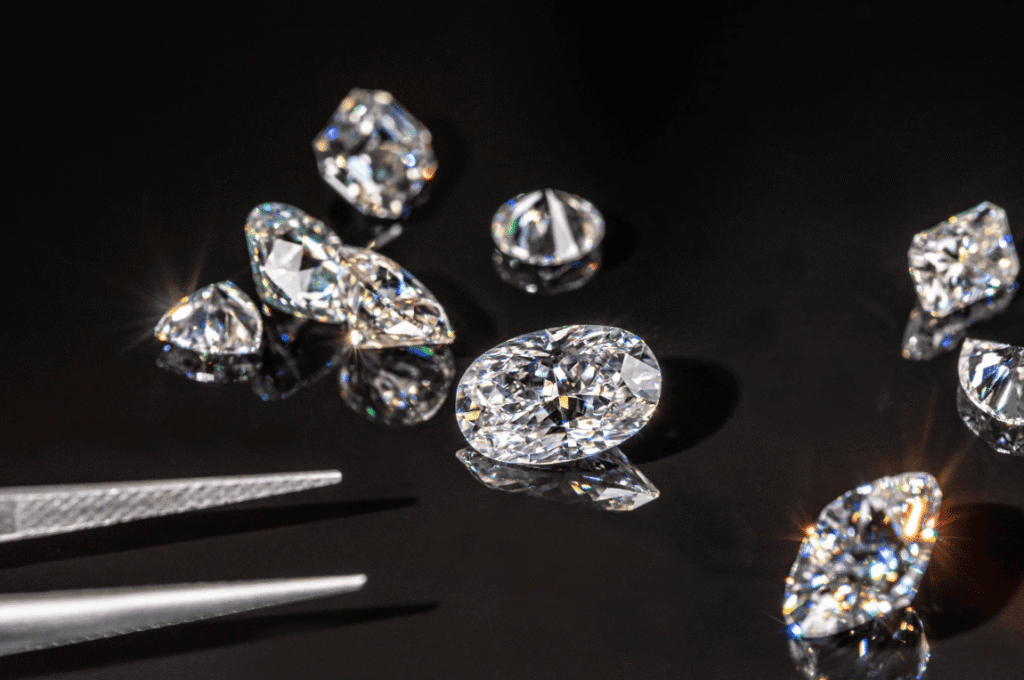
The cut of a diamond is crucial to its appearance and value and is the most complex and technically demanding identification standard among the 4C diamond standards.
Many people misunderstand diamond cut as the shape of the diamond (round, heart, oval, marquise, pear). A diamond's cut grade depends on how its facets interact with light. The evaluation of cut includes "cut proportion", "symmetry" and "polishing".
An excellent cut can create a high refractive index, making the diamond shine brightly.
Different diamond grading agencies have different classifications of cut grades.
GIA is cut into five grades
Excellent,EX: There are only slight bad facet shapes or hard-to-find polishing lines, which do not affect the light reflection of the diamond at all. It has uniform light and dark areas and extremely colourful fire reflections, and the polishing or symmetry is excellent. Excellent, the other rated it as excellent.
Very Good,VG: There are only slight polishing lines or inconspicuous surface features, which do not affect the reflective ability of the diamond. It has very few broken light and dark areas, good fire reflection, and polishing or symmetry is excellent or one of them is excellent.
Good (G): Some transparent polish lines can be seen on the front, many small surface features, facet asymmetry or proportional deviations at the base of the crown, and large dark areas on the front.
Fair (F): There are obvious transparent or white mist-like polishing lines on the front, obvious surface features or proportional deviations, no obvious contrast between light and dark on the front, and the overall appearance is dull.
Poor: Surface features that reduce the transparency of the diamond and obvious symmetry deviations.
IGI is divided cutting into six levels. Above Excellent and EX, there is an additional level of Ideal, with Ideal as the top cut.
The cut of a diamond directly affects its
Brightness: White light reflected from the interior and exterior of a diamond.
Fire colour: White light is scattered into colourful spectral colours.
Sparkle: The total amount of scintillation produced by a diamond is related to the number of facets of the diamond. The more facets of the diamond, the stronger the sparkle will be.
Diamond clarity refers to the evaluation of diamond surface flaws or diamond internal characteristics, foreign crystals or diamond crystals that were included in the original ore when the diamond was formed, structural detects produced during the growth process, or external detects produced during artificial cutting. They are all called; the clarity characteristics of general gem-quality diamonds are invisible to the naked eye. Under 10x magnification, they are determined according to size, number, position, nature and reality. Determines the clarity grade of a diamond.
Diamond clarity standards are divided into 6 categories and 11 grades.
Flawless (FL): When viewed under a 10x magnifying glass, the diamond does not have any inclusions or surface features.
Internally flawless (IF) No visible inclusions when viewed under a 10x magnifying glass.
Very slightly included grades (VVS1 and VVS2) are observed under a 10x magnifying glass. There are very small inclusions inside the diamond, which are difficult to see even for professional appraisers.
Slightly included grades (VS1 and VS 2) are observed under a 10x magnitying glass. Tiny inclusions can be seen inside the diamond.
Slightly included grades (SI1 and S12) are observed under a 10x magnifying glass. The diamond has visible inclusions.
Inclusions in grades (11, 12 and 13) may affect the diamond's transparency and brilliance. Inclusions are visible under 10x magnification.
The higher the clarity of the diamond, the higher the value.
Diamonds are graded based on their colour. A completely colourless diamond without any chemical impurities is considered the most valuable. However, such diamonds are rare to find. Most diamonds have a slight brown or yellowish hue. The grades range from “D” to “Z”, with subtle distinctions in between.
Grades D, E, and F are considered colourless, while G, H, and I are considered nearly colourless. It’s hard to see the difference between D, E, and F with the naked eye, but comparing diamonds with slightly different grades can reveal the difference.
Though the colour difference may be subtle, it impacts the diamond’s quality and price significantly.
The weight of a diamond is measured in carats, and 1 carat is equivalent to 200 milligrams, so the carat weight is accurate to two decimal places. As a unit of mass, one carat can be divided into 100 points, which can be used as a smaller unit of measurement, for
example: a diamond of 20 points = 0.2 carats.
All other things being equal, the larger the diamond, the more valuable it is. However, even if two diamonds have the same carat weight, their value (and price) can be significantly different. Because the value of a diamond also depends on three other criteria in the 4Cs of diamonds: clarity, colour and cut.
《Want to learn more about lab grown diamonds?》 Click the link below for a free consultation where our experts will provide you with additional information about diamonds.